
You have decided on glass. It is the right call for the Okanagan, where the view is the whole point of the deck. But now you face a second decision that most homeowners do not expect: topless or framed?
They sound similar, and both are made of tempered glass, but they are genuinely different systems with different looks, costs, and ideal uses. Choosing wrong means either overspending on a spot that did not need it, or under-building the one railing that frames your best view. This guide walks through topless glass railings in Kelowna versus framed glass railings so you can match the system to your deck with confidence.
The Core Difference in One Minute
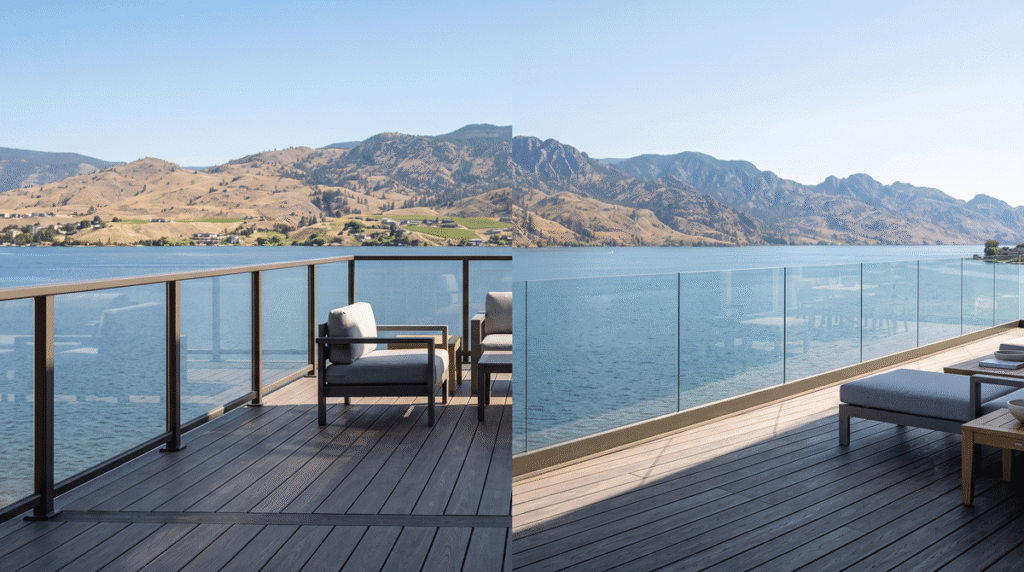
A framed glass railing holds each glass panel inside an aluminum frame, with a top rail running along the top edge and channels or posts around the perimeter. The frame carries the structural load so that the glass can be thinner (typically 5mm). It is clean, secure, and cost-effective.
A topless glass railing, also called frameless, removes the top rail entirely. The glass panels stand on a low-profile base or post system with nothing across the top edge, so nothing interrupts the sightline. Because the glass itself is now structural, it is thicker: 10mm or 12mm tempered safety glass.
Put simply: framed glass gives you a defined, framed picture of your view. Topless glass removes the frame so there is nothing between you and the horizon.
Views: Topless Wins, and It Is Not Close
If preserving your view is the priority, topless glass is the system built for it. Standard railing designs obstruct 30 to 50 percent of your sightline through top rails, posts, and hardware. A topless system removes the top rail and uses a post that reduces visible mounting hardware dramatically, so the glass is what you see, not the aluminum holding it.
For a lakefront deck overlooking Okanagan Lake, an elevated balcony facing Kalamalka or Wood Lake, or a mountain-facing patio, that difference is the entire experience. You lean on the railing, and there is nothing between you and the water.
Framed glass still offers an excellent view compared to pickets or cable, but the top rail and frame create a visible horizontal line across your panorama; for many spots, that is perfectly fine. For your primary view corridor, it is the compromise topless glass was designed to eliminate.
Cost: Framed Is the Budget-Friendly Choice
Framed glass is the more affordable glass system. The aluminum frame carries the load, allowing thinner 5mm glass and simpler engineering, which brings the price down. Topless glass costs more because it requires thicker structural glass, precise fabrication, and an engineered post system; installed topless projects typically run $200 to $350+ per linear foot.
That cost gap is exactly why so many well-designed Okanagan decks use both. Homeowners reserve topless glass for the view side where it matters most, and use framed glass or aluminum picket railings on side elevations and stairs. With a consistent powder-coat colour across systems, the property still reads as one cohesive design while the budget goes where it counts. For a full breakdown of pricing, see our Kelowna glass railing cost guide.
Glass Thickness: 10mm vs. 12mm Explained
If you go topless, you will choose between 10mm and 12mm tempered glass. Both are safety glass that exceeds BC Building Code guardrail requirements. The difference is rigidity.
10mm is the standard choice for most residential decks and balconies. It offers excellent clarity and strength and is the right pick for typical, moderately exposed installations.
12mm provides additional rigidity and is recommended for exposed wind zones, installations above the second storey, and commercial applications. On the windy, elevated decks common around the Okanagan, that extra thickness keeps the system solid and rattle-free through decades of weather.
Framed systems, by contrast, generally use 5mm glass because the frame does the structural work. If a contractor recommends thicker glass for your topless project, it is not an upsell for its own sake: it is matching the material to your wind exposure and elevation.
Wind, Weather, and the Okanagan Factor
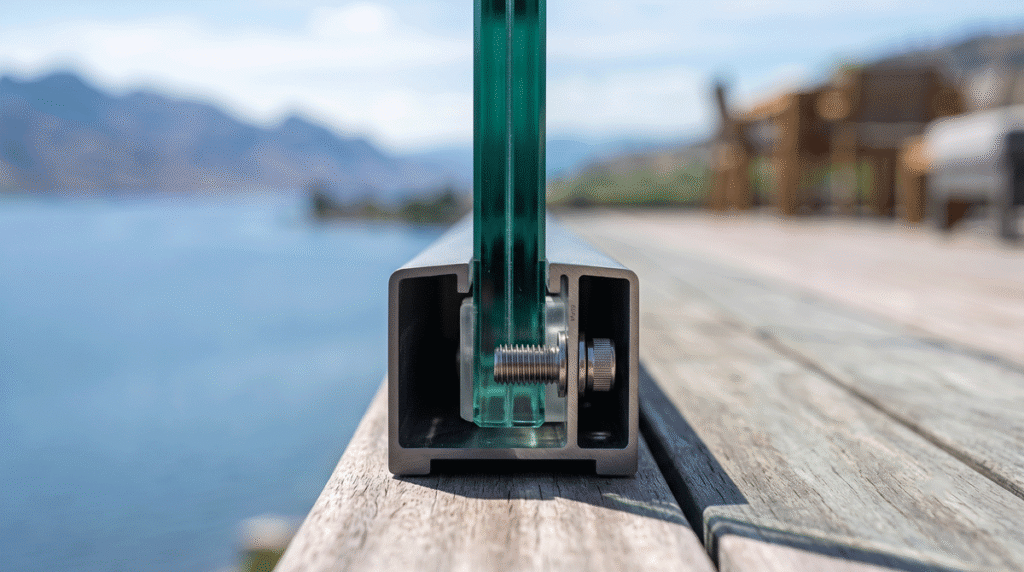
Cheap glass railings fail in BC weather. Systems that are not engineered for the Okanagan’s freeze-thaw cycles, intense summer UV, and wind loads deteriorate faster: gaskets crack, glass shifts in its channels, and posts corrode.
Both framed and topless can be built to perform here, but topless demands more engineering precision because the glass is structural. This is where the installer matters more than the system category. A properly engineered topless railing with 12mm glass and a quality post system will outperform a poorly installed framed system, and vice versa. The lesson: choose your system for your view and budget, but choose your installer for the engineering.
Maintenance: Both Are Low, Both Beat Wood
Here is the good news, whichever way you lean: both glass systems are far lower maintenance than wood. There is no staining, no sanding, no annual repainting. Tempered glass cleans with standard glass cleaner, and powder-coated aluminum posts resist corrosion and UV without refinishing.
Framed systems have slightly more surface area where dust and pollen collect along the frame and channels so that they may want a wipe-down a bit more often. Topless systems have less hardware to clean but more visible glass, so smudges and water spots show more readily on a panel with nothing across the top. Neither is demanding. An occasional clean keeps both looking new for years.
Which Should You Choose? A Quick Decision Guide
Choose topless glass if: your deck frames a lake, valley, or mountain view; you want the most modern, high-end look; you are on an elevated balcony where the view is the feature; or you are finishing a premium or lakefront property where resale value rewards the upgrade.
Choose framed glass if: you want the clarity of glass at a friendlier price; the railing is on a stairway, side yard, or secondary elevation; you like the defined, structured look of a framed panel; or you are balancing a budget across a large deck.
Choose a combination if: you have one standout view and several ordinary runs. This is the most common recommendation we make, because it puts your money where the view is.
Why Homeowners Choose Legacy Glass Railings for Topless Systems
Not all “topless” systems are equal, and this is where Legacy Glass Railings stands apart in Kelowna. Founded in 2018 by Dax and Kaid, we developed a proprietary 12-mil low-profile post system that sits just 12 inches above the deck, versus the standard 40-inch post, and reduces visible mounting hardware by up to 70 percent compared with generic systems. That is the difference between a truly frameless look and one that still shows a bulky aluminum profile.
Every topless installation is fabricated in-house at our Kelowna facility, engineered to your property’s specific wind exposure and elevation, and delivered with stamped engineering documentation for inspections and resale. You choose from 9 standard powder-coat colours or a custom match, in surface-mount or fascia-mount configurations. It is all backed by 90+ five-star Google reviews, 300+ completed projects, and a completion guarantee that means we do not collect final payment until you confirm the work is perfect. Browse our portfolio to see topless and framed systems in real Okanagan homes.
See the 12-Mil Difference for Yourself.
The best way to decide between topless and framed is to see your deck through an expert’s eyes. Book a free on-site consultation or call 250-863-2394, and we will assess your view, structure, and budget, then recommend the system and the glass thickness that is right for your Okanagan property.
Frequently Asked Questions
What is the difference between topless and framed glass railings?
Framed glass railings hold each panel in an aluminum frame with a top rail, using thinner 5mm glass. Topless (frameless) railings remove the top rail so the glass stands on a low-profile post system, using thicker 10mm or 12mm structural glass for an unobstructed view. Topless preserves more of your sightline; framed is more budget-friendly.
Are topless glass railings more expensive than framed?
Yes. Topless glass railings cost more because they use thicker structural glass and an engineered post system, typically $200 to $350+ per linear foot installed. Framed glass is the more affordable glass option since the aluminum frame carries the load and allows thinner glass. Many decks combine both to balance cost and views.
Should I choose 10mm or 12mm glass for a topless railing?
10mm tempered glass is the standard choice for most residential decks and balconies. 12mm is recommended for exposed wind zones, installations above the second storey, and commercial applications where extra rigidity is needed. On windy or elevated Okanagan decks, 12mm keeps the system solid and rattle-free.
Are frameless glass railings safe and BC code compliant?
Yes. Topless glass railings use tempered safety glass engineered to meet or exceed BC Building Code guardrail load and height requirements. A proper installation includes stamped engineering documentation, and the continuous glass surface eliminates the climbable horizontal elements found in traditional picket or cable railings.